August 4, 2026 · 10 min read · Analook Editorial Team
Competitive Intelligence Case Study: AI Startup Business Model
Competitive intelligence is useful when it changes a decision. In this anonymized case, it helped a research-led, open-source AI startup stop copying the category's hosted-SaaS playbook and build a more defensible enterprise revenue engine.
Privacy note: company, product, founder, customer, partner, campaign, contract, timeline, revenue, growth, and implementation details are removed or generalized. The companion commercialization case study covers execution; this article focuses only on competitive-intelligence decisions.

Anonymized case signals
- Starting point: strong research credibility, weak monetization
- Category pattern: competitors converging on hosted SaaS
- Strategic wedge: a defensible enterprise outcome
- Distribution: open source became an established trust channel
- Commercial outcome: repeatable enterprise revenue
What was the competitive-intelligence question?
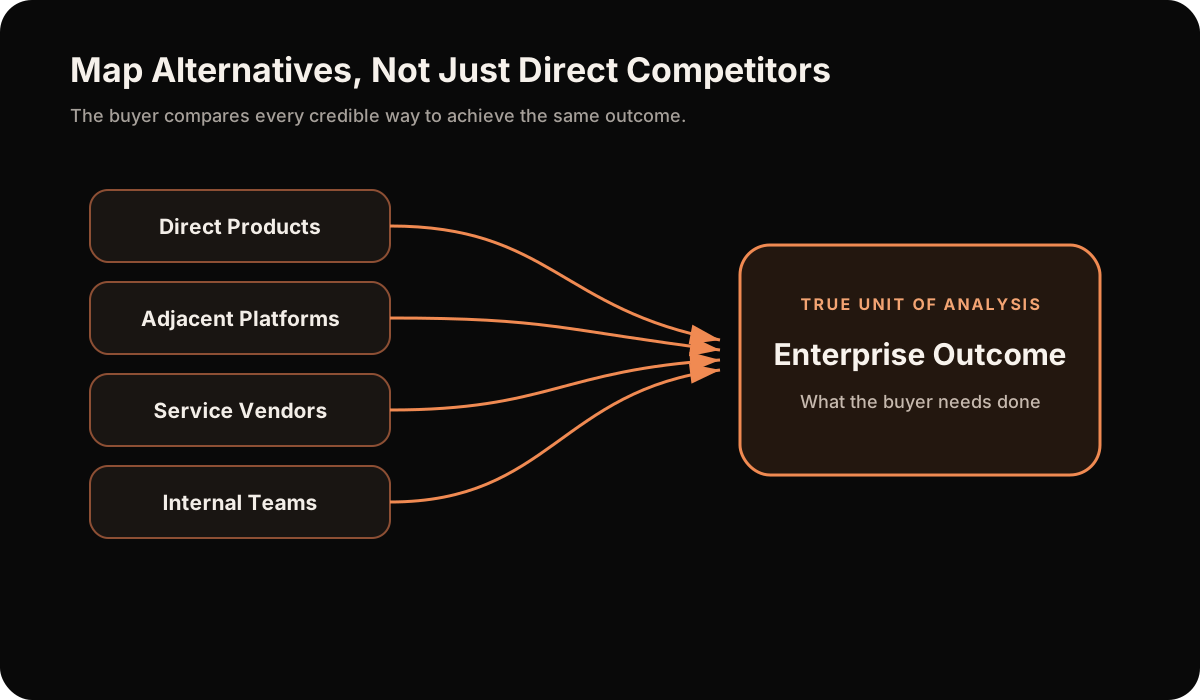
The competitive-intelligence question was not “which framework has more features?” but “where is value accumulating in this market?” The review compared direct products with adjacent alternatives and existing buyer workflows. That wider set mattered because a team can win a feature comparison and still choose the wrong business. The category's visible companies were clustering around hosted developer tooling, while anonymized commercial evidence pointed toward a more defensible paid outcome. This changed the unit of analysis. Instead of benchmarking “framework versus framework,” the team compared the enterprise outcome with every other way a buyer could obtain it. The resulting map exposed a less crowded market without disclosing the buyer, deliverable, evaluation method, or procurement path.
Which four signals made hosted SaaS look unattractive?
The hosted-SaaS warning was a pattern of four competitive signals, not a philosophical objection to subscriptions. First, developer adoption and budget ownership were separated: users loved the repository, but enterprise leaders controlled spend. Second, competitors with more capital were already bundling hosting, integrations, and polished developer experience. Third, pricing pages looked similar, which indicated weak differentiation and likely margin pressure. Fourth, the startup's custom projects repeatedly centered on a specialized enterprise outcome rather than generic hosting. Our working notes showed the same buyer language returning across calls, while the feature matrix kept expanding without improving willingness to pay. Together, those signals suggested that a hosted layer could remain useful as supporting infrastructure but should not become the primary commercial thesis. The decision was reversible: test standardized offers first, retain the open-source core, and fund SaaS features only when they improved enterprise delivery or repeat purchase behavior.
How did competitor research reveal the enterprise wedge?
The enterprise wedge was defined as a paid outcome that alternatives could not easily reproduce without the startup's technical system and accumulated learning. The team mapped direct products, adjacent platforms, service alternatives, and existing workflows, then assessed them using broad commercial and delivery criteria. The startup's advantage was not merely lower cost: each delivery could improve the underlying system. Competitive intelligence then shaped a repeatable, outcome-oriented offer rather than undifferentiated project work. The exact deliverable, buyer, evaluation method, operating workflow, and contract details are intentionally withheld.
How did market signals change packaging and sales?
Market-signal packaging means translating competitive evidence into an offer customers can compare, approve, and repurchase. We reviewed how adjacent vendors separated licenses, implementation, support, and training, then adapted that logic without copying their products. A standard enterprise scope reduced ambiguity; implementation and training became visible line items; support levels defined response commitments; and partner margins made the offer distributable. Sales-cycle evidence also changed account selection. Long strategic projects remained possible, but they no longer consumed the entire pipeline. The team prioritized buyers who could purchase substantially the same outcome within a shorter window, then asked whether a second company in the segment would accept the same scope. We tracked switching evidence rather than vanity pipeline: what the customer did before, why it failed, who approved the budget, and what acceptance test closed the deal. Those fields turned competitor research into pricing, qualification, and revenue operations.
What did recurring competitive monitoring actually track?
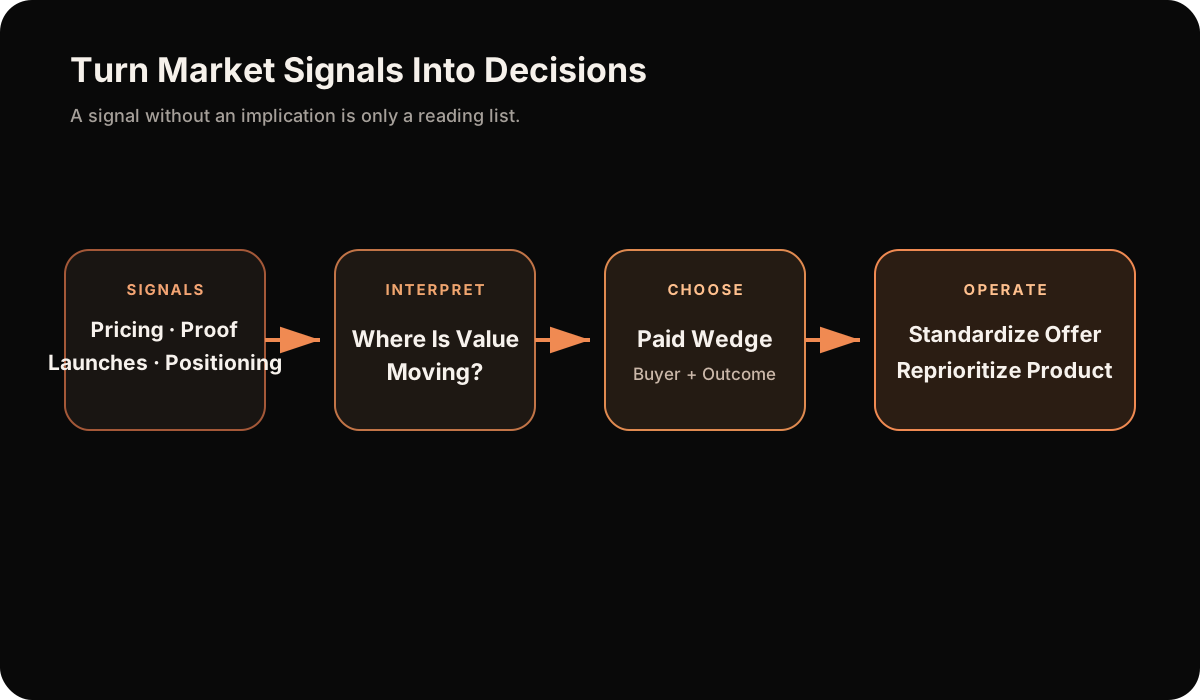
Competitive monitoring is useful when it supports decisions rather than collecting screenshots. The team reviewed public changes in pricing, proof, product direction, positioning, and distribution, then recorded only signals with a plausible implication for the offer or roadmap. Analook-style multi-source tracking can reduce manual tab work, but the operating rule matters more than the tool: every retained signal needs an implication. The specific events, cadence, response criteria, production workflow, platforms, and performance metrics are intentionally withheld. The reusable lesson is to connect monitoring to a named decision; otherwise alerts become a reading list rather than a growth system.
How did intelligence affect product priorities?
Competitive-priority planning means allocating resources according to commercial evidence and strategic defensibility. The startup ranked initiatives using five fields: buyer urgency, time to revenue, repeatability, competitive crowding, and founder dependency. Enterprise delivery and the core paid outcome became P0. The stable product capabilities required by those buyers also remained P0. Research releases and community operations continued as P2 maintenance because they supported trust, recruiting, and distribution, but they could not consume the same resources as the revenue engines. This was not a permanent verdict on open source; it was a response to the company's current constraint. Quarterly reviews could promote or demote an initiative when buyer evidence changed. The competitive map also made stopping decisions easier: if a proposed feature merely matched a better-funded rival and did not strengthen the enterprise wedge, it was delayed. Strategy became a portfolio of explicit bets rather than a backlog shaped by the loudest request.
What should founders copy—and what should they avoid?
The reusable competitive-intelligence playbook is a decision loop: map alternatives, identify value migration, test one paid wedge, and update priorities from evidence. Include existing workarounds—not only direct products—and compare them using fields relevant to your own market. Validate the hypothesis with buyers, test a paid offer, and ask whether the same broad outcome can be repeated. Review signals regularly and refresh the full map less often. Avoid three traps: feature matrices without buyer data, reactive campaigns without a conversion path, and confidential numbers presented as precise public proof. The outcome was a collective company effort; competitive intelligence helped redirect decisions, but it did not cause the result alone. Use the method to improve your odds, not to manufacture certainty.
A one-page competitive-intelligence template
| Field | Question | Decision it informs |
|---|---|---|
| Economic buyer | Who owns the budget? | ICP and sales motion |
| Paid outcome | What does the buyer approve? | Offer design |
| Current alternative | What happens without you? | True competitive set |
| Switching trigger | Why change now? | Positioning |
| Pricing structure | What is standard vs. custom? | Packaging |
| Delivery burden | What still depends on founders? | Scalability |
| Defensible asset | What compounds after each sale? | Business-model choice |
Use this alongside the 10-step competitive analysis template and the competitor research workflow for founders. If the page does not change a product, pricing, positioning, or channel decision, it is not finished.
Frequently asked questions
How can competitive intelligence change a startup business model?
It reveals where competitors are crowded, which buyers control budgets, how alternatives package value, and where an internal capability can become a more defensible paid outcome.
What should an open-source startup track about competitors?
Track buyer, paid outcome, pricing model, sales cycle, distribution channel, implementation burden, and customer switching evidence. Feature matrices alone rarely explain where revenue will come from.
Is this AI startup case study anonymous?
Yes. Names, products, customers, event references, contracts, exact dates, and exact figures were removed or generalized to prevent reverse identification.
How often should founders review competitive signals?
Use a lightweight recurring review and a deeper periodic strategy review. A change only matters when it affects buyer behavior, positioning, pricing, distribution, or product priorities.
What is the best output of competitor research?
A decision. Useful research should change who you sell to, what outcome you package, which channel you use, or what you stop building.
Run the analysis, not the tab marathon
Analook brings competitor positioning, launch, SEO, and market signals into one workflow so founders can spend less time collecting pages and more time deciding what to do next.